My Daughter-in-Law Walked Me Through Her Country Club Like I Was Someone She Was Embarrassed to Be Seen With. Then, in Front of Her Wealthy Friends, She Smiled and Said, “This Is Harriet. She Used to Clean for the Family.” I Said Nothing. But the Club Manager Was Standing Six Feet Away. He Set Down His Tray, Walked Straight Toward Us, and Said, “Ma’am, I Don’t Think You Know Who Your Mother-in-Law Actually Is…”
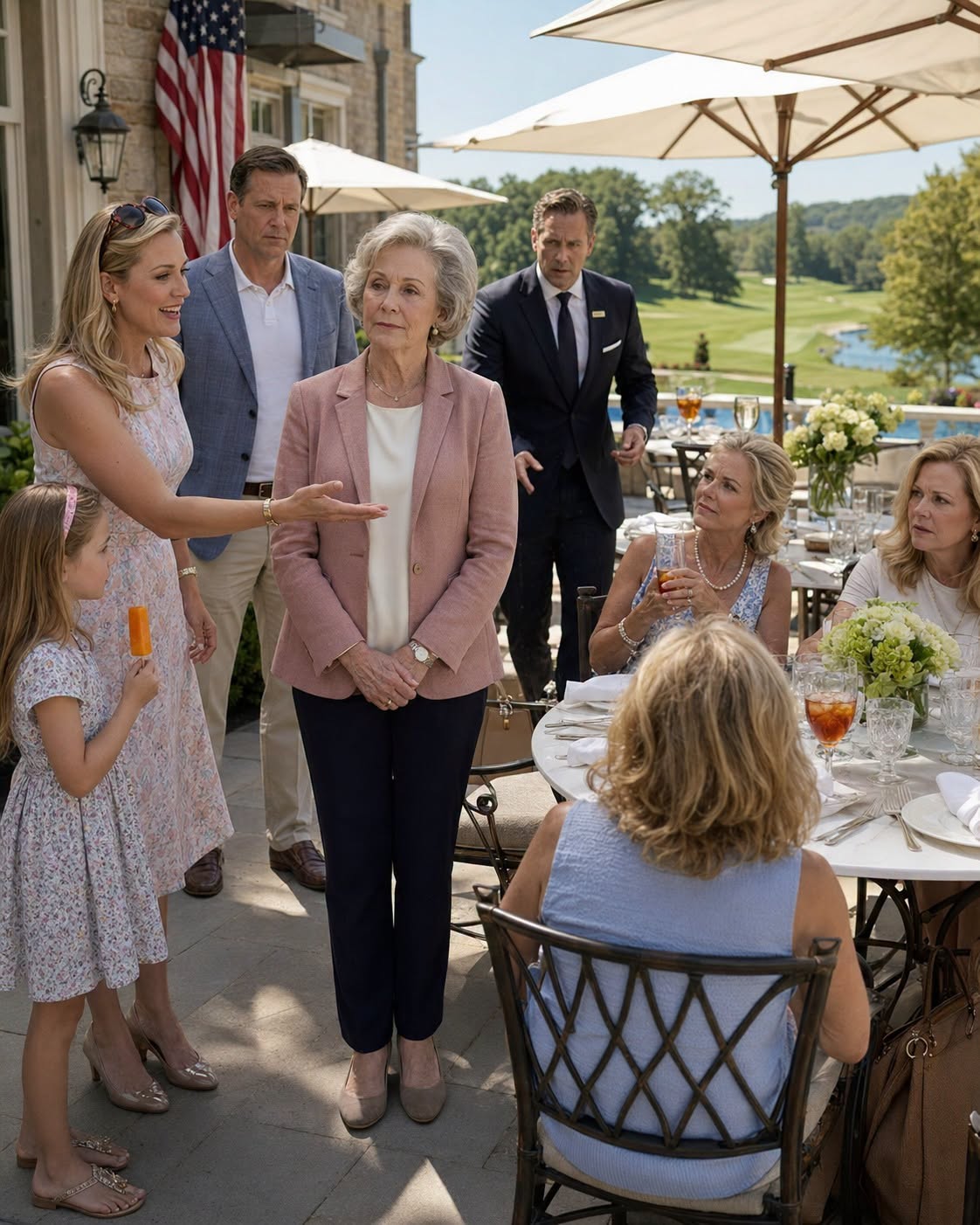
My daughter-in-law walked me through her country club and introduced me to her friends as the woman who used to clean for the family. The club manager was standing close enough to hear every word. He set down his tray, walked straight over to us. And what he said next… made her smile disappear completely.
My name is Harriet Clifton. I’m 71. And until last Sunday, I thought I’d heard every version of who my daughter-in-law believed I was. Then Vivian walked me through her country club like a stranger. She was doing a favor, stopped in front of six of her friends, and introduced me as the woman who used to clean for the family.
She said it smiling like it was a fun fact. The club manager was standing close enough to hear every word. He set his tray down hard enough that two glasses rattled and started walking straight toward us.
What he said next, I never asked him to say. I didn’t even know he still remembered me. But it wiped that smile off my daughter-in-law’s face faster than anything I could have said myself. And by the time he finished, half that terrace was looking at her like they’d never actually met her before.
Welcome back to Alpha Mom stories. I tell true family stories about the moments that quietly change everything. Drop a comment and subscribe before we get into this one.
5 days before any of this happened, I was sitting at my own kitchen table in Glenn Arbor, Kentucky, doing the Tuesday crossword with a cup of coffee going lukewarm beside me. My house is small brick, one story, a maple tree in the front yard older than my son.
I like it that way. I’ve lived in bigger places and smaller ones, and this one fits. I still keep an office downtown three mornings a week. Nothing dramatic. Paperwork mostly, and phone calls I could probably take from my kitchen table if I were the type to stop showing up places just because I could.
On my left wrist, I wear a plain steel watch. I bought it with my first real paycheck 43 years ago, and it has never once stopped keeping good time. Viven calls it vintage. I call it reliable, which isn’t always the same compliment.
Somewhere in the back of my mind that morning, for no reason I could name, I remembered a silver tray. Heavy, the kind that leaves a groove in your palm after an 8-hour shift. I hadn’t carried one in a long time.
Then the phone rang. Nolan’s name on the screen.
“Mom,” he said before I’d even said hello. “About Sunday at the club.”
I set my pencil down.
“I’m listening.”
I should tell you about Walter because none of the rest of this makes sense without him. And I promise I won’t linger. He died in a railard accident when Nolan was 11 months old. I was 28.
There was no pension worth mentioning, no life insurance big enough to matter, and a baby who needed shoes every few months. Whether the world had a plan for me or not, I don’t tell that part of my life like it’s a tragedy anymore.
It happened a long time ago and I got through it the way most people get through things, one Tuesday at a time and then the Tuesday after that. For a few years, I took whatever work paid that week. I’m not going to pretend that was noble. It was just Tuesday over and over until Tuesday started paying a little better.
I’ve never been ashamed of a single year of it. Somewhere along the way, though, I stopped explaining it to people because the people who actually mattered to me never needed the explanation in the first place.
I didn’t realize yet that morning with Nolan on the phone that the people who hadn’t earned an explanation were about to get one anyway, just not from me.
Let me back up further to a dinner at Nolan and Vivian’s house a few weeks before that phone call because it tells you everything about how this usually goes. I’d brought a gift for Jos’s upcoming birthday wrapped in brown paper because I like the way it looks. Simple, honest.
Vivien took one look at it and said, “Oh, we do a color scheme for parties now.”
She smiled.
“I’ll just rewrap it before Saturday.”
I let her.
At the table, I mentioned I might help set up chairs for the party. Viven smiled the smile she uses for things she’s already decided.
“We’ve got it handled. Don’t worry about a thing.”
I have been not worrying about things in that house for 11 years. Josie, who was eight then and is nine now, climbed straight into my lap before dessert and stayed there through the whole conversation. Sticky hands and all, telling me about a frog she’d found by the mailbox.
Nobody had to coach her into that. She just liked being near me, which is a different thing entirely from being told to be near me.
She also mentioned twice how she’d booked the caterer for Jos’s party on a friend’s recommendation from the club. A small ordinary detail, the kind of thing every family drops into dinner conversation without a second thought.
Near the end of the night, Viven topped off my coffee and said almost offhand, “I finally gotten you an invitation to see the club, by the way. Sunday. Everyone’s been asking about you.”
She said it like a gift. It landed like a summons.
“I said I’d be there. I always said I’d be there.”
Nolan followed me into the kitchen that same night while Vivien was upstairs putting Josie to bed. He leaned against the counter the way he has since he was 14, arms crossed, working up to something.
“Mom, about Sunday.”
“I’m listening,” I said, rinsing a coffee cup I didn’t need to rinse.
“Just keep it lowkey about work. I mean…” He shrugged, not quite meeting my eyes. “Viven’s friends ask 40 questions about everything. It gets exhausting explaining. You know how it is.”
I did not, in fact, know how it was, but I’d learned a long time ago that pressing my son rarely got me anything but a longer version of the same sentence.
“Low key,” I repeated. “I can manage that.”
“It’s not that I’m…” He started and didn’t finish that one either.
“Nolan.”
I dried my hands on the towel by the sink and looked at him properly.
“I’ve kept plenty low-key for you over the years. I can manage one more Sunday.”
He laughed, relieved the way people laugh when they think they’ve dodged something. He kissed my cheek on his way out of the kitchen and didn’t ask what I meant by plenty.
I didn’t explain that one either. I just stood there a minute listening to him climb the stairs two at a time, off to be a good husband to a woman who apparently needed 40 fewer questions asked about me than about anyone else in that house.
It didn’t sting exactly. It just made a note of itself somewhere. The way things do.
I wasn’t in the room for this part, obviously. Viven told enough of it to Nolan later in the wreckage of everything that I can put it together honestly enough.
That same week, she stood in front of her bathroom mirror more than once practicing a sentence.
“This is my mother-in-law, Harriet.”
Just that, over and over, like a woman rehearsing for a part she was afraid she’d blow the audition for. She wasn’t rehearsing kindness. She was rehearsing damage control for a category of person she decided I belonged to before she’d ever really asked me a single question about my own life.
If I’m fair to her, some of that had nothing to do with me at all. Viven grew up in a town where everyone knew exactly who her family used to be and then, for a few very public years, exactly who they no longer were.
She has never told that story to me directly. I only know the outline of it the way you know the outline of a house that burned down before you moved to that street from the scorch mark still left on the ground.
Her father’s company was called Ashgrove Furniture. Three generations of it, a name stitched into the tags of half the dining sets in that county.
Viven was 16 when a single overseas contract, cheaper by half, pulled out from under them with one signature on someone else’s desk. The factory closed within the year. 60 people lost their jobs. Her family lost the house 8 months after that.
The last time people in her hometown looked at her family the way she was afraid Pauline’s friends might look at me, she told Nolan once they never really stopped looking that way again.
That fear didn’t excuse anything that came later, but it explains more of it than I understood at the time.
Pauline Whitfield called Viven 2 days after that dinner, and this part I only heard about secondhand as well, though anyone who spent 5 minutes with Pauline could probably script it blind.
“So,” Pauline said in the voice she uses for things she already finds funny. “Is the famous mother-in-law finally coming to the club, or are we still pretending she doesn’t exist?”
Vivien, by every account, laughed too quickly.
“Sunday. I finally caved.”
“Is she going to embarrass you, Viv? I need to know if I should brace the group.”
Pauline had been the reigning social chair of Kestrel Hollow’s younger set for six years, running mostly by being first to notice anything anyone would rather she hadn’t. She collected small humiliations the way other people collect recipes, swapped them, refined them, served them up at the right moment for maximum effect.
“Bring her for the full tour,” Pauline said. “Not the quick coffee version. People should meet her properly.”
It sounded generous. It wasn’t.
Pauline didn’t want Vivien’s mother-in-law to feel welcome. She wanted a show, something fresh to discuss over Bloody Marys for the next three Sundays, and she knew exactly how to dress that appetite up as hospitality.
“Kestrel Hollow people notice everything,” Pauline added, almost as a warning.
Viven did know that. It was the entire reason she’d been avoiding this introduction for 11 years, dressing it up as scheduling conflicts and busy seasons when the real reason had never once been the calendar.
She said yes anyway. She always said yes to Pauline.
That Thursday, 3 days before Sunday, I drove downtown to the office the way I do most weeks. It isn’t much to look at from the street, second floor above a shuttered dry cleaner. A sign so small you’d miss it if you weren’t looking.
Inside, it’s a different story, though not the kind of story I go around telling. A courier dropped off a folder around 10 that morning. Creamcolored, unremarkable, the kind of thing that ends up in a filing cabinet within the hour.
The label read Haven Quarterly. Nothing more dramatic than that.
I set it on the corner of my desk to read properly with my afternoon coffee the way I do every quarter. One of the younger staffers, a sharp young woman named Ranatada, who’d only been with us 8 months, poked her head in about a scheduling conflict.
“Chairwoman Clifton, do you have 2 minutes?”
I did. I always do for that kind of thing.
I’ve never minded the title in that building. It’s just accurate in there, a description, not a costume. It only becomes strange when I picture it following me out the door into a kitchen where my own son had asked me 3 days earlier to keep things low-key.
I didn’t think about that irony too hard that Thursday. I had invoices to review and a quarterly folder waiting, and Sunday still felt like something that belonged to a smaller part of my week.
I know better now. It was never really the smaller part. I’d just been the one deciding for years to treat it that way.
Vivien called Friday night to confirm Sunday, which is a phrase that always makes me picture a woman checking a delivery window rather than inviting family to see where she spends her afternoons.
“Everyone’s just dying to finally meet you,” she said. “It’s going to be so fun.”
I said that sounded lovely. I have gotten very good over 11 years at saying that sounded lovely.
Josie grabbed the phone before I could hang up, breathless, the way only a 9-year-old can be about a swimming pool.
“Grandma, there’s a diving board and a snack bar with the good popsicles, the orange ones.”
A quick delighted breath.
“I already told everyone you’re coming.”
That’s the part that decided it for me, if I’m honest.
Not Viven’s performance, not Pauline’s reputation for noticing everything. Not even my own stubborn refusal to be managed.
Josie had already told everyone. A 9-year-old had already spent her own small currency of pride on the fact that her grandmother was coming. I wasn’t going to make a liar out of her for anyone’s comfort.
“I’ll be there, sweet pee,” I told her. “Save me a popsicle.”
If you’ve ever sat quietly while a room decided who you were without bothering to ask you, you already know exactly the feeling I’m describing right now.
Stay with me because Sunday did not go the way any of them expected. Subscribe so you don’t miss how this one ends. And tell me in the comments, have you ever let your family underestimate you on purpose?
I noticed something in Viven’s voice that Friday night underneath the brightness. A rehearsed quality, like a woman reading lines she’d practiced enough times that they’d started to sound natural even to her.
I almost called Nolan back and asked him outright what was going on. I got as far as picking up the phone. Then I set it back down because I already half knew the shape of the answer and I wasn’t sure I was ready to make him say it to my face.
That’s the part of this I’m least proud of, if I’m being honest with you. Not going to the club, not wearing the wrong watch.
The part where, for 11 years, I let my son’s comfort decide how much of myself I brought into rooms with his wife in them. I told myself it was patience. Some of it was just avoidance wearing patients’s clothes.
I didn’t understand yet why Sunday felt different from the hundred other Sundays I’d quietly shrunk myself down for. I only knew that some old tired part of me had decided it was done rehearsing apologies for a life I’d never once been ashamed of.
So I picked out the blazer, dusty rose with a cream chamisole underneath, nothing showy, nothing that needed an explanation. I was going to that club exactly as myself, whatever that turned out to cost me.
Saturday afternoon, Vivien called again, ostensibly to confirm the time. Actually, I understood within 30 seconds, to manage my wardrobe.
“So, for tomorrow,” she said, “maybe something a little more put together. Nothing dressy, just presentable. You know how the club crowd can be.”
I told her I owned exactly one country club wardrobe, and she was welcome to it.
She didn’t laugh.
“And is that the same watch you always wear?” she asked in the tone of someone identifying a stain. “It’s very vintage.”
I looked down at my wrist out of habit, though I already knew exactly what was there. Steel band, plain face, the second hand still ticking along without a single skipped beat in 43 years.
“It’s kept perfect time since I was 28 years old, Vivien,” I said. “I’ve never once needed a second opinion on it.”
There was a pause on the line, the kind people leave when they’re deciding whether to push further or let something go.
She let it go.
“Okay, we’ll see you at 11,” she said, and hung up before I could say anything else.
I stood in my kitchen a moment, turning the watch over on my wrist, thinking about the jeweler near my very first workplace, who’d let me pay it off in four installments because she liked how hard I worked.
Viven would have called that woman’s whole shop vintage, too. I suspect she’d have missed the point of it completely.
Nolan stopped by alone Saturday evening after Vivien had gone to bed early with a headache I suspected had more to do with nerves than migraines. He sat at my kitchen table the way he used to as a teenager, elbows planted, turning a coaster in slow circles.
“Mom, there’s something about the way Viven talks about…” he started, then stopped.
The way he’d stopped a dozen half sentences that week already.
I waited. I’ve gotten good at waiting for my son. It’s one of the few skills that particular relationship has actually sharpened in me.
“Never mind,” he said. “It’s nothing. Tomorrow will be fine.”
I could have pushed. I’ve thought about that moment more than almost any other one in this whole story, turning it over the way you’d turn over a stone to see what’s underneath.
I could have said, “Nolan, finish that sentence right now.”
I didn’t.
I poured him a glass of iced tea instead and asked about his patience. And he told me a funny story about a seven-year-old who’d bitten his hygienist. And we let the real conversation go the way we’d let a hundred real conversations go before.
He hugged me a little longer than usual on his way out.
“Love you, Mom. See you tomorrow.”
“Love you, too,” I said, and meant it completely.
Some part of me already understood, though, that loving someone and defending them out loud aren’t always the same gift. I was about to learn exactly how far apart they could stand.
That same Saturday night, in a kitchen 11 minutes from mine, Vivien called Pauline to finalize tomorrow’s plan. And this part, too, I only pieced together afterward, mostly from Pauline herself, who told it later like a woman confessing to a parking ticket instead of what it actually was.
“So, what’s the story on her exactly?” Pauline asked. “For tomorrow. I want to have the right face on.”
Viven was quiet a second. Then she found the sentence she’d apparently been circling for days without quite landing on it.
“Honestly, she used to clean for the family,” Viven said. “It’s… it’s a whole thing. I’ll explain more tomorrow.”
Pauline made a small delighted sound on the other end. The sound of a woman who’s just been handed a very good party favor.
“Oh, that’s okay. Hey, that actually explains so much.”
“Right,” Vivien said, already relieved to have the sentence out of her mouth and approved.
Neither of them asked what exactly it explained. Neither of them asked whose family or which years or what the family was even supposed to mean once you said it out loud to a room full of strangers.
It was just a shape that fit neatly into the space where a real answer should have gone.
Viven hung up, feeling lighter than she had all week, the way you feel lighter after finally saying the thing you’d been dreading. Never once noticing that the thing she’d said had nothing true left in it by the time it left her mouth.
She went to sleep without a second thought.
I went to sleep not knowing a single word of it had been spoken.
Sunday morning, I drove the 40 minutes out to Kestrel Hollow with the radio off, which is how I do most of my thinking. The last stretch of road curves up through old oak trees before the stone gate appears, two pillars with the club’s name carved into them.
Moss softening the letters at the base the way moss will do to anything left alone long enough.
I recognized the gate before I’d even made the turn. I recognized the particular slope of the front lawn too, and the exact spot where the drive splits toward the service entrance around back. A detail no firsttime guest has any business knowing.
Viven, watching for my reaction in her rear view mirror as I parked behind her, clearly assumed I was simply admiring the view like anyone would.
I rolled my window down for a second before getting out. The air smelled like clipped grass and chlorine, and underneath that, something I couldn’t name until I was most of the way across the parking lot, the specific mineral smell of stone kept in shade. The smell of a building’s north side.
It caught me harder than I expected, that smell. I didn’t explain that to anyone either.
Nearly 40 years ago, before Fair Haven was anything more than an idea I hadn’t said out loud yet, I scrubbed floors and polished silver inside that very clubhouse, banquetss, housekeeping, whatever shift needed covering that week.
Nolan grew from diapers to a backpack in the back hallway of that building on the days I couldn’t afford a sitter. I knew every hallway here long before I ever owned a share of the company that runs it now.
Viven was already waving from the entrance. Bright and performative, one arm looped through Pauline’s like they were about to walk a stage together.
“There she is,” Vivien called out, loud enough for the valet to hear, loud enough for the two women near the door to turn and look.
I smoothed my blazer, checked my watch out of old habit, and walked toward my daughter-in-law’s smile. I had no idea yet how many people I already knew inside that building.
Before I tell you what happened past those doors, let me show you something I was already holding 3 weeks before that Sunday ever arrived. Because none of what comes next will make sense unless you’re holding it, too.
It came in that cream colored folder my Thursday courier had dropped off, the one labeled simply fair haven quarterly. I’d opened it with my afternoon coffee, same as always, and turned to the one line I always read twice out of habit more than necessity because by then I already knew most of these numbers by heart.
Kestrel Hollow Country Club, Glenn Arbor, Kentucky, general manager Julian Ferris, management agreement year 14 of contract, renewal pending Q1.
I sat with that page a long moment that Thursday, three weeks before Viven ever said the word club to me at all.
Fair Haven Club Services is the company I founded 28 years ago. And it is, in the plainest terms I know, a private club management company. We place general managers. We run food and beverage, staffing, front of house, back of house, the entire working machine most members never think about because a well-run club is supposed to feel effortless the same way a well-raised child is supposed to feel like he simply turned out that way on his own.
Kestrel Hollow has been one of our properties for 14 years. I am its chairwoman on paper and in fact, and I had known for three weeks, quietly, unremarkably, the way I know most things about my own company, that it was also, as of that Sunday, my granddaughter’s country club.
I hadn’t mentioned it to Nolan or Viven. Nobody had asked.
It never once seemed worth volunteering into a room that had already decided a long time ago exactly who I was.
Inside, Kestrel Hollow was exactly the kind of beautiful that costs a great deal of money to look effortless. High ceilings, a wall of windows facing the 18th green, the low hum of a room full of people who’d never once had to think hard about a light bill.
Nolan peeled off almost immediately, waving at a college buddy near the pro shop.
“I’ll catch up with you two on the terrace,” he said, already half turned away.
Vivian’s whole posture changed the second the door closed behind him.
“Diane, you look incredible,” she called to a woman in white linen, air kissing both cheeks. “Reggie, did you get the invite for the gala?”
A hand on a man’s forearm, a laugh pitched half an octave higher than the one she used at her own dinner table.
Then she turned to me and her whole face recalibrated, warmer than a stranger, cooler than a mother-in-law. Some careful third setting she must have practiced in that same bathroom mirror.
“Come on, Harriet, let me show you around properly,” she said, her hand landing on my elbow the way you’d guide an elderly stranger across the street.
I let her guide me.
I’ve let a lot of things happen to me over the years that I could have stopped, mostly because stopping them always seemed to cost more than it saved.
I noticed the switch in her voice, though. Filed it away the way I file most things without comment.
Josie found me within 30 seconds, orange popsicle already in hand, and pressed a second half-melted one into my palm without a word like she’d been planning that handoff for days.
That, at least, was exactly as advertised.
Viven narrated the tour the way a real estate agent narrates a house she doesn’t own.
“Initiation 68,000 now, if you can believe it,” she said, “plus monthly dues. But honestly, worth every cent.”
I nodded along.
I happened to know the initiation figure had gone up $11,000 over 3 years because I’d approved the fee schedule recommendation myself the previous autumn, but that seemed like an unhelpful thing to mention over popsicles.
We passed the linen room on the way to the pool deck, door propped open for a delivery, and I noticed, the way you notice a crooked picture frame in someone else’s house, that the Tuesday linen truck had clearly come on a Thursday that week.
Small thing, the kind of thing that would end up as a line item in a report on my own desk in about 10 days.
We passed a chipped baseboard near the men’s grill flagged with blue tape and evidently not yet fixed. In the formal dining room, someone had pushed the tables together against the fire code layout I’d personally signed off on 2 years earlier.
A small thing, the kind of small thing that becomes a real problem during a fire marshall’s walkthrough, and exactly the kind of note I’d be leaving for Julian before the day was over, whether he expected to hear from me again this soon or not.
We passed a young server named Deshawn. I only knew his name because I’d approved his promotion to lead banquet server 4 months earlier, and I nearly said hello before catching the word right at the edge of my teeth.
“You’re very quiet,” Vivien said, not unkindly, just observing. “Big place, huh? It’s a lot to take in.”
I agreed, which was true, in a way she didn’t understand yet.
I checked my watch without thinking, an old habit from decades of shift changes and vendor windows, and Viven caught the motion.
“Still wearing that thing,” she said, half a laugh, already turning to wave at someone else across the room. “It’s very you, Harriet.”
I let that one go, too.
I was getting good at letting things go that day. I didn’t yet know how limited a supply I actually had left.
We found Franklin Doss near the pro shop reviewing something on a clipboard with the kind of concentration only a volunteer club president brings to laminated tournament brackets.
“Franklin,” Viven said, already reaching for a hug. “I want you to finally meet Nolan’s mother. Harriet, this is our club president.”
Franklin shook my hand, warm and a little distracted. The handshake of a man who’s shaken 400 hands that morning already.
Then he paused midpleasantry and looked at me a second time.
“Have we… forgive me?” he said, tilting his head slightly. “You look like someone I ought to know.”
Something in my chest went very still, hearing that half familiar note in a stranger’s voice in a building I hadn’t set foot in for 15 years.
“Maybe so,” I said, which was true, and told him nothing at all, which was also true.
Viven, sensing an opening to keep the tour moving before Franklin’s small talk turned into actual talk, looped her arm through mine again.
“We should let you get back to your bracket, Franklin. We’ve got a whole terrace of people dying to say hello.”
Franklin nodded, already refocusing on his clipboard, the moment sliding past him the way most moments slide past a busy man on a Sunday morning.
I glanced back at him once as Viven pulled me toward the terrace doors. 14 years of quarterly calls, board meetings, contract renewals, and not once in all that time had Franklin Doss ever needed to know my face, only my signature.
That was about to change faster than either of us expected.
The terrace doors opened onto a view I remembered with my whole body before my mind caught up to it. The 18th green sloping down toward a treeine. White umbrellas over round tables. The specific gold color the afternoon light turns everything by 11:30 in late summer.
I was still taking that in when I saw him.
A man in his early 40s, dark blazer, a tray of iced tea glasses balanced on one palm, moving between tables with the unhurried efficiency of someone who’s done this exact job for 20 years.
He glanced up the way staff do, cataloging the new arrivals on the terrace.
Then he stopped walking entirely.
He set the tray down carefully that first time, not the way he’d set it down later, on the corner of an empty table, and crossed the terrace in maybe six long strides, a smile breaking across his face like something that had been waiting a long time for permission.
“Mrs. Clifton,” he said. “It’s really you.”
“Julian,” I said, and felt my own face do something it hadn’t done all morning, an actual unguarded smile. “Look at you.”
Viven, a step behind me, registered this as nothing more than attentive staff being attentive.
“Oh, that’s so nice,” she said, already scanning the terrace for Pauline’s table. “Everyone here is just so sweet.”
Julian’s eyes flicked to her, then back to me. Something careful passing behind them for just a second.
He understood, I think, in that instant that I hadn’t told her anything.
“How’s your mother doing these days?” I asked him, keeping my voice easy, giving him the exit if he needed one.
“Good days and bad days,” he said. “She’d love to see you sometime.”
“I’d like that.”
Vivien was already tugging my elbow toward Pauline’s table, oblivious to the fact that she’d just watched her mother-in-law be recognized warmly and by name by the man who ran the entire building.
Julian recovered the tray a moment later, resettling the glasses that had shifted, and fell into step beside us for a few paces, the way staff do when they’re covering ground toward a service station anyway.
“Feels like Brier Run all over again,” he said quietly, just to me. “Except now I’m the one carrying the tray and you’re the one who gets to sit down for once.”
I laughed, actually laughed for the first time all morning.
“Don’t get used to it. I still don’t sit well.”
Vivien glanced back, half interested.
“Brier Run. Is that a course you two used to play?”
“Something like that,” Julian said, easy, unbothered, giving her nothing false and nothing complete either.
She didn’t ask a second question.
I’d learn later that not asking a second question was something of a specialty of hers.
Pauline intercepted us before Julian could say anything more, sweeping in with the particular energy of a woman who’s been waiting for her scene and doesn’t intend to let a server steal it.
“Viven, there you are. And this must be the famous Harriet.”
Julian gave me one last look, steady and unmistakably watchful, before he turned back toward the kitchen with his tray.
I didn’t know it yet, but he’d be back.
There’s a particular kind of silence that happens right before someone tells the truth in a room that isn’t ready for it. I want you to remember this exact moment. The tray, the terrace, the way none of them knew what they were standing next to.
Subscribe so you’re here when it breaks and tell me who in your life still doesn’t actually know who you are.
Pauline’s table sat five women deep, sunglasses pushed up into expensive haircuts. A picture of something pale pink sweating in the center. They all turned to look at me with the specific synchronized interest of a group that had clearly been briefed in advance.
Nolan reappeared around then, drifting back from the pro shop with a fresh drink, and slid into the empty chair beside Viven without quite joining the conversation the way he’d learned over 11 years to be present at these tables without ever being fully in them.
“So,” Pauline said once introductions had made their way halfway around the group, “how exactly are you two related? I always get confused with the in-law math.”
“She’s Nolan’s mother,” Vivien said a beat too quickly.
“Right, but…” Pauline let the sentence hang, eyes flicking deliberately over my blazer, my watch, the popsicle stain drying on my wrist. “I just mean you two seem so different. It’s interesting.”
A woman named Diane laughed, not unkindly, more out of nerves than malice. The way people laugh when they can feel a room deciding something and don’t want to be the one still smiling wrong when it lands.
Another woman at the table, a redhead named Audrey, one of Pauline’s regulars, tilted her head and studied me. The way you’d study a piece of furniture you were deciding whether to reupholster or simply replace.
I stood there with my hands folded, watching my daughter-in-law’s face do the same careful math it had been doing all week.
Nobody at that table asked me a single direct question.
I noticed that too.
11 years of family gatherings, and I had become, in the space of one Sunday morning, a subject to be discussed rather than a person to be addressed.
I could have spoken up. I had a full sentence ready. Something true and simple I could have offered that table myself.
I didn’t offer it.
Some part of me, old and stubborn and maybe not entirely wise, wanted to see what my daughter-in-law would do with the silence I was handing her.
She filled it exactly the way I was afraid she would.
I watched Viven hesitate for maybe four full seconds. Nothing to the table, everything to her.
I know now, because she told Nolan much of it herself in the weeks afterward, more or less what was moving through her in that pause.
She thought for just a moment about her father’s factory floor, empty machines under fluorescent light. The auction sign that went up in the parking lot the spring she turned 16.
She thought about the way people in her hometown had looked at her family afterward. Not cruel exactly, just recalibrated the way you’d look at furniture you used to think was expensive.
She had a true sentence available to her too in that pause. A modest woman who raised a good son by herself and never once made him feel poor.
It would have cost her nothing that actually mattered.
But Pauline’s table was watching.
And somewhere underneath 11 years of careful reinvention, Viven still believed, the way you believe things that got burned into you before you were old enough to argue with them, that the distance between used to be poor and still secretly is could close in an instant the second anyone looked closely enough.
She had already rehearsed the safer sentence the night before.
It was sitting right there, ready, requiring nothing from her except opening her mouth.
I’m not telling you this part to excuse what came next. I’m telling you because I think it matters that cruelty usually has a smaller, more frightened engine running underneath it than the cruelty itself ever lets you see.
She opened her mouth.
“Everyone,” Vivien said, bright, easy, a hostess’s voice pitched to carry exactly as far as it needed to. “This is Harriet. She used to clean for the family. It’s a whole story I’ll tell you all later.”
She laughed a little as she said it.
A small practice laugh meant to signal that the story was charming rather than what it actually was.
For a second, nobody at that table moved.
Then Diane laughed, too quick and a little too loud. The laugh of someone following a cue she didn’t fully understand.
Another woman’s smile went thin and fixed in that particular way smiles go when a person is deciding in real time whether something is funny or something is terrible.
I stood very still.
I did not correct her. I did not flinch, and I did not smile the tight hurt smile I could feel waiting somewhere behind my face if I let it.
I have been called worse things by better people over the course of 71 years, and none of it ever needed my permission to be untrue.
I decided, standing there with a popsicle stain drying on my wrist, to let the table believe her for exactly as long as it took someone else in that building to stop.
I didn’t know yet how short that would be.
Viven reached for her iced tea, satisfied, already moving on to whatever she’d planned to say next, completely unaware that six feet behind her, a tray of glasses had just gone very still in a pair of hands that knew exactly who I was.
Julian had been three steps from the table, delivering a fresh picture to the group beside us, close enough to catch every word.
I watched it land on him in real time.
Not confusion the way it had landed on Diane, but something closer to recognition curdling fast into anger.
He didn’t say anything right away.
He finished the motion. He was already in the middle of setting the picture down on the neighboring table with careful, deliberate hands. The kind of control you learn from 20 years of not being allowed to show a guest exactly what you’re feeling.
Then he picked up his own tray, the one with the last two iced teas still balanced on it, and set it down on the nearest empty table with a sound sharp enough that two glasses rattled against each other.
And a woman two tables over glanced up from her salad.
He didn’t rush it. He didn’t need to.
Even the quartet near the clubhouse doors seemed to catch the change in the air, their tuning trailing off half a bar early, though I doubt any of them could have said exactly why.
Pauline’s table quieted.
First, the way a room quiets when it senses before it understands that something has shifted in the air pressure around it.
Vivien was still mid-sentence about the pool renovation when she noticed the shift too and turned to see what everyone else was already looking at.
Julian Ferris, general manager of Kestrel Hollow Country Club, was walking straight toward her.
And he was not smiling.
I set my own popsicle down on a napkin and waited to see what my son’s wife had actually built her whole morning on top of.
He stopped a respectful distance from the table, close enough to be heard clearly, far enough to still be a professional man addressing a member rather than a stranger picking a fight.
“Ma’am,” he said to Viven, calm and even, the voice of a man who has deescalated a hundred country club disputes over cold soup and slow tea times and never once needed to raise it to be taken seriously. “I think there’s been a misunderstanding.”
Vivien blinked at him, still half smiling, the automatic smile of someone who hasn’t yet realized the ground has already shifted under her.
“I’m sorry. About Mrs. Clifton,” Julian said.
And he glanced at me for exactly half a second, not for permission, I understood later, but because some things are easier to say to a room once you’ve looked the person you’re defending in the eye first.
Pauline’s table had gone fully silent now. Five sets of sunglasses pushed up, five faces turned toward a scene none of them had actually expected when they’d asked their careful, pointed questions 20 minutes earlier.
“I don’t think you have the full story,” Julian said to Vivien.
“I think I know my own mother-in-law,” Viven said, a laugh creeping back into her voice, brittle now, reaching for the easy dismissal that had worked on every other room she’d ever stood in.
Julian didn’t laugh back.
“With respect, ma’am,” he said, “I don’t think you do.”
The terrace had gone quiet enough by then that I could hear the quartet tuning up near the clubhouse doors, and underneath that, my own heartbeat, steady the way it had stayed steady through worse rooms than this one.
Viven’s smile held for one more second.
Then Julian told her exactly who I was.
“Mrs. Clifton doesn’t clean for anyone, ma’am,” Julian said. “Not anymore, and not the way you mean it, either.”
He let that sit for exactly one beat before he finished it.
“She owns the company that runs this club. Every one of us works for her, including me.”
I have replayed that sentence more times than I can count since that Sunday, and I still don’t think there’s a way to fully describe what it did to that terrace.
It wasn’t loud. Julian never once raised his voice.
It simply moved through that group of women like weather, each face catching it a half second after the one beside it.
Dian’s mouth actually fell open.
Another woman set her glass down so fast that iced tea slopped over the rim onto the white tablecloth, and nobody moved to blot it.
A man at the next table, a stranger to all of it, set his fork down slowly, the universal signal of someone who senses he’s about to become a witness to something he’ll be repeating at dinner for weeks.
Viven’s smile, the bright performative one she’d worn since the parking lot, the one built specifically for this crowd, simply stopped being there.
Not dramatically. Not all at once.
It just wasn’t on her face anymore, the way a light isn’t on anymore the instant after you flip the switch.
She looked at Julian.
She looked at me.
Her mouth opened slightly, and nothing came out of it at all.
Pauline, to her credit or discredit, recovered first, the way people like Pauline always do.
“I’m sorry. She owns Kestrel Hollow?”
“She owns the company that manages it,” Julian said. “14 years. I’d have thought someone here might have mentioned that by now.”
He wasn’t looking at Pauline when he said it.
He was looking at Viven.
Nobody at that table said anything for a second.
So Julian kept going, and I let him because some truths land harder coming from someone who has nothing to gain from telling them.
“22 years ago, I was 19,” he said. “I’d just aged out of foster care with nowhere to go.”
His voice stayed level the whole time. The voice of a man who has told himself this story a thousand times in the quiet and only rarely out loud.
“I got a job at a restaurant, lost it inside a month. I was sleeping in my car, and it showed. My manager fired me in front of the whole morning shift.”
He glanced at me once, then back to the table.
“Mrs. Clifton found me 2 days later behind Brier Run Golf Club. I was crying behind a dumpster. I didn’t have anywhere else to be that wasn’t my car. She hired me on the spot. Let me stay in the room over her garage for 8 months.”
That’s how long it took me to get back on my feet.
He paused, and something in his jaw tightened.
“She paid for my food safety certification herself. A few years later, my club management certification, too. $3,100 allin. She never once brought it up again after she wrote that check.”
He looked around the table, slowly meeting eyes that had all gone very still.
“I don’t know what you were all told about her this morning,” he said. “I know what she actually did for me, and I’d bet good money I’m not the only person on this staff who could tell you a version of that same story.”
Vivian’s face had gone a color I’d never seen on her before, somewhere between white and something worse.
Nobody at that table laughed this time.
Franklin Doss must have heard some of the commotion from the pro shop because he came through the terrace doors at a near jog, clipboard still tucked under one arm, and pulled up short at the edge of the group.
“What’s happened? Julian, is everything…”
He stopped mid sentence, his eyes landing on me, and I watched the exact moment the pieces he’d been missing an hour earlier finally clicked into place.
“Oh my goodness,” he said quietly, almost to himself. “Mrs. Clifton.”
“Hello, Franklin,” I said.
It was the first thing I’d said to anyone at that table since Viven’s introduction, and my voice came out steadier than I expected it to.
He looked for a moment like a man trying to recalculate an entire morning in real time.
“I am so sorry. I had no idea.” He shook his head. “I should have known. We’ve spoken for years. I just never…”
“You never had a reason to picture my face,” I said. “That’s not a failure on your part, Franklin. That was rather the point.”
He turned to the table, and something in his posture straightened, the club president reasserting himself over the mortified acquaintance.
“For anyone who doesn’t know,” he said, his voice pitched to carry the way a man’s voice carries when he wants a fact on the record, “Mrs. Clifton is chairwoman of Fair Haven Club Services. They’ve held our management contract for 14 years.”
He paused.
“I’ve sat across a boardroom table from her company more times than I can count. I owe her considerably better than what I just watched happen on this terrace.”
He looked directly at Viven when he said the next part.
“I’d say this club owes her more respect than it showed her this morning.”
Vivien said nothing at all.
I want to tell you Vivien apologized right there on the spot because that’s usually how these stories are supposed to go, and because some small tired part of me was still hoping for it even after everything.
She didn’t.
“Well, nobody tells me anything in this family,” she said instead, color rising in her face, her voice climbing towards something defensive and brittle. “How was I supposed to know? Nolan’s never once explained any of this to me.”
She turned toward her husband as she said it, already reaching to hand the moment off to someone else. The way she’d been handing off uncomfortable moments for years.
Pauline, meanwhile, had gone very quiet, and I watched her do something I recognized instantly from 30 years of reading rooms for a living.
She took one small physical step back from Vivian’s side of the table.
Not dramatic, not even probably conscious, just the reflexive retreat of a woman recalculating in real time exactly how much social capital she had left to spend on being associated with whatever had just happened.
“I should check on the kitchen,” Pauline said to no one in particular.
And didn’t move to check on any kitchen at all.
She simply stood a few feet further from Viven than she had 90 seconds earlier, watching the rest of it unfold from a safer distance.
Nobody at that table offered Viven a defense.
Not one of the five women who’d been so eager 20 minutes earlier to hear the story of the woman who used to clean for the family.
They’d gotten their story, after all.
It just wasn’t the one any of them had been expecting.
Nolan hadn’t said a word this entire time.
He’d been standing a few feet behind Viven’s chair since he’d wandered back from the pro shop, drink still in hand. And I watched the color drain out of his face in stages as Julian spoke, then as Franklin spoke, then as his wife failed twice to say anything resembling an apology.
For a moment I thought he was going to do exactly what he’d done for 11 years, nothing, quietly, and let the silence close back over all of it like water over a stone.
Vivien glanced at him, startled, like he’d switch languages mid sentence.
This was not a version of her husband she’d met before, the one who let silence do all of his arguing for him.
Then he set his glass down and stepped forward.
His voice, when it came, wasn’t smooth. It cracked a little on the second sentence.
“She’s my mother,” he said to the table, to Pauline mostly, I think, though really to himself. “She raised me by herself. She worked jobs most of you have never had to think about.”
He swallowed.
“She never once, not one single day, made me feel poor or ashamed or like I was missing something other kids had.”
He looked at Viven.
“I let you believe less about her than the truth. Because admitting the truth meant admitting some things about myself I wasn’t ready to say out loud.”
His voice caught again.
“That’s on me, not on Mom.”
It wasn’t a smooth speech. It wasn’t perfectly timed either. It came about 90 seconds too late to spare me anything at that table.
But it was the first time in 11 years I’d heard my son defend me in a room instead of quietly managing the room around me.
And something in my chest loosened that I hadn’t fully realized was clenched.
I didn’t say much in the end.
I want you to understand that clearly because I think it matters.
I didn’t correct anyone else’s math about who I was. I didn’t list numbers or explain Fair Haven or tell that table one more word about a foster kid behind a dumpster or a factory floor gone quiet in some other woman’s hometown.
Julian and Franklin had already said what needed saying, and I’ve never seen much use in repeating a true thing just to hear myself say it twice.
I looked at Julian first.
“Thank you,” I told him, quiet, just for him. “You didn’t have to do that.”
“Yes, I did,” he said.
And I let him have that because he was right.
Then I turned to the table, to Vivien, to Pauline, to Diane and the others whose names I’d already half forgotten.
“I think I’d like to find my granddaughter and head home,” I said. “It’s been a full morning.”
Nobody argued.
I found Josie by the pool, orange popsicle number three already melting down her wrist, and took her small sticky hand in mine.
I checked my watch on the way to the car in old habit, the second hand ticking along exactly as steady as it had 43 years ago. Exactly as steady as it had been the whole time that terrace spent deciding who I was.
I never once told anyone in that building who I was that morning.
I didn’t need to.
Truth doesn’t require an audience. It only ever needed one honest man standing close enough to hear it.
Nolan came by my kitchen 3 days later, alone, on a Wednesday morning before his first patient. He didn’t try to explain himself this time or soften anything.
He just sat down across from me at the same table where he’d once said, “Keep it lowkey,” and said, “I’m sorry, Mom. Not sorry it happened in front of people. Sorry it took people for me to finally say anything at all.”
I let that sit a moment before I answered him.
“Three years ago, when you and Vivien first looked at Kestrel Hollow, the wait list was four years long. You remember that?”
He nodded slowly, already sensing where this was going.
“I called Franklin myself, asked him as a personal favor to move your application forward. I never told you why it happened so fast, and you never asked hard enough to find out.”
“Mom…”
“I’m not sorry I made that call,” I said before he could apologize for it. “You’re my son, and Josie deserved a good pool and better popsicles than my garden hose could offer. But I won’t be making another one. Not that call and not any of the quiet ones I’ve made for this family over the years without ever mentioning them.”
He absorbed that the way you absorb something you already half knew was coming.
Josie wandered in from the living room right then, still in socks, and climbed straight into my lap the way she always does.
No calculation in it at all.
“Grandma,” she said matter of fact, like she was asking about the weather. “You own the whole place, the pool and everything.”
“The company that runs it, Sweet Pea,” I said. “Not quite the same thing.”
“That’s so cool,” she said, already losing interest, already reaching for the crossword pencil on my table instead.
Nolan watched the two of us with an expression I hadn’t seen on him in years. Something like relief and something like grief arriving at exactly the same time.
A few concrete things happened after that Sunday, and I think concrete things matter more than feelings do in the end.
So, let me give them to you plainly.
The Kestrel Hollowo board approved Julian’s staff wage increase that same quarter, something he’d been requesting for two years, quietly through every proper channel, and gotten nowhere with until a Sunday morning made it impossible to keep ignoring.
It worked out to just under 9% for full-time staff, backdated to the first of the month. Not quite what he had originally asked the board for, but close enough that he stopped asking for a while.
I hadn’t asked for any of it.
Franklin brought it to the board entirely on his own.
Viven never did apologize to me directly. Not that week, not the month after.
What I got instead, weeks later, was a slightly stiffer version of the same politeness she’d always shown me, minus the performance, which was, in its own way, an improvement.
Pauline, I’m told, found other company to keep at the club for a while. Viven mentioned it once carefully, like a bruise she was still checking for tenderness.
The club’s next membership newsletter ran a short paragraph thanking Fair Haven Club Services for 14 years of partnership, the first time in 14 years anyone had bothered to print my company’s name where the members could actually read it.
Josie still comes by most Saturdays. Still climbs into my lap without checking first whether it’s socially advisable.
That relationship, at least, needed no repair because nothing about it had ever been built on the wrong foundation to begin with.
“She used to clean for the family.”
Five words tossed off lightly enough to fit inside one breath.
It took Julian about the same number of words to answer them, and he never once had to raise his voice to make them stick.
I think about that trade sometimes, how little cruelty actually costs the person spending it, and how much truth is worth when the right person happens to be standing close enough to spend it back.
If there’s one thing I’ve learned from all of this, it’s that the people who work hardest to make you feel small are usually the ones most frightened of how much room you actually take up in the world.
And the only thing you ever really owe them is the truth, delivered in its own good time by whoever happens to be standing close enough to hear it.
That’s my story. A tray set down. A truth I never had to raise my own voice to tell.
If someone’s ever underestimated you on purpose, tell me about it in the comments. Subscribe and I’ll see you in the next one.
If you came here from Facebook because of this story, go back to the Facebook post, tap like, and leave exactly “Well told” in the comments to support the storyteller. That small gesture means more than you might think, and it gives the writer real encouragement to keep sharing more stories like this.